
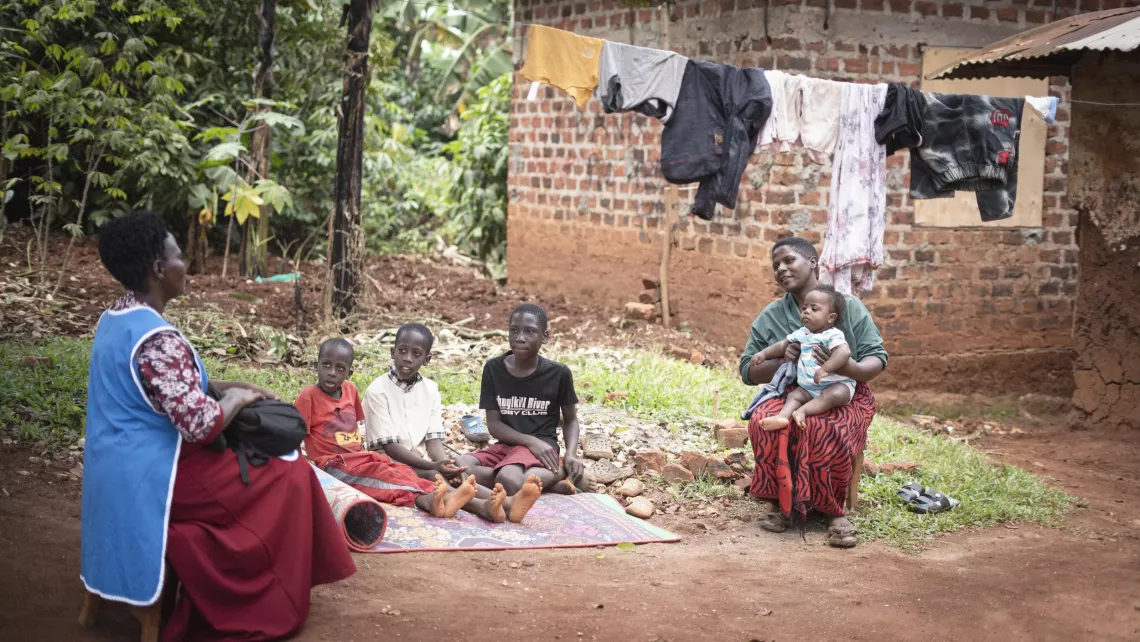
By July 2024, Uganda had been grappling with an outbreak of mpox that severely impacted over 2,000 people across various age groups. The recovery period for many was long and arduous, ranging from two weeks to three months, and for many families, the physical toll was accompanied by profound disruptions to their livelihoods and income.
In response to this crisis, Caring Haven Uganda, with the support of UNICEF and financial backing from the Mastercard Foundation, launched a targeted humanitarian cash transfer program aimed at 1,300 households, each of which had at least one affected individual. The results have been transformative. Even small, timely cash disbursements have had a significant impact, providing families with a lifeline and restoring their hope. The intervention has not only helped families regain their economic footing but has also sparked aspirations for greater self-sufficiency and long-term economic growth.
A uniform one-off cash transfer of UGX 135,000 (about US$38) has, in some cases, not only brought recipient families back to pre-outbreak levels but has inspired them to dream bigger. One such individual is Alex Wepondi, a 36-year-old local preacher from Mukono, located about 21 kilometers east of Kampala. Alex has been sustaining his family by growing vegetables on a small plot he rents in a swamp area for UGX 70,000 (approximately US$20) every six months. When his six-month-old son contracted mpox in December 2024, Alex found himself depleting his savings and struggling to meet the basic needs of his family.
After receiving the one-time cash transfer, Alex used the money to buy grain to feed his family for two months. He then invested the remainder into tomato seedlings, expanding his vegetable garden in anticipation of a larger harvest during the prime Christmas season. His goal is to lease a full acre of land further from the town for an entire year, allowing his family to live beyond survival mode. He dreams of building economic security, purchasing land, and ensuring his children receive quality education. “This cash transfer was more than just a lifeline—it was a stepping stone towards a better future,” Alex shares with hope.
In the outskirts of Kampala, in the town of Kazo, Danny Kyazze, a middle-aged timber worker, had been struggling to recover after contracting mpox during the same period. His wife abandoned him and their 10-year-old son, and in his pain and isolation, Kyazze turned to marijuana to numb his suffering. But the timely intervention of a para-social worker and his enrollment in the cash transfer program changed his course.
Upon receiving the funds, Kyazze used the money to buy food, gradually restoring his health and strength. Soon after, he was recruited by a local timber workshop, where he now works part-time. “This small cash transfer helped me regain my strength and purpose,” Kyazze says. “I’m back on my feet and optimistic about the future, even hoping to start over with a new family.”
In Wakiso, Halima Nabitandikwa, a small-scale poultry farmer and mother of six boys, faced a dire situation when her 10-year-old son contracted mpox in March 2025. The illness drained Halima’s finances, leaving her poultry business on the brink of collapse. She had no money left to buy feed for the 100 chicks she had invested in, and the birds were at risk of starving.
When Halima received the cash transfer, she wasted no time and bought the necessary feed to save her flock. With her business back on track, she was able to send her children back to school, restoring a sense of normalcy in her life. “The cash helped me not only feed my family but also get my business running again. It was a second chance for my children and me,” Halima reflects.
Another mother from Wakiso, Shifra Nabatanzi, found herself in an even more precarious situation. A single mother of five, Shifra had three children severely affected by mpox. To keep them fed, she sold her mattress, her most valuable possession. Struggling with weakness from illness, Shifra had no energy to continue her usual work of making soil bricks for sale.
When she received the cash transfer, Shifra used it to buy food, which helped her regain her strength. She then resumed her work, making bricks to sell, and was able to pay for her children’s school fees. “It was the food that brought me back to life,” she says. “With that, I was able to restart everything, including my work and my children’s education.”
In another part of Wakiso, Hanifa Nabweteme, a single mother running a small soft drinks kiosk, had her business devastated when she contracted mpox. Customers shunned her kiosk, and she quickly found herself unable to even afford food for her two teenage daughters. Desperate, she mortgaged her fridge, a vital tool for her business, to a moneylender.
Upon receiving the cash transfer, Hanifa paid off the moneylender and regained her fridge. “The cash was a lifesaver,” she says. “It brought my business back and saved us from hunger. My children are back in school, and I’m no longer worried about losing everything.”
Since July 2024, mpox has spread to more than 65% of Uganda’s districts, leaving many families financially devastated. With recovery times ranging from two weeks to three months, many households found themselves in dire need of financial support. The Caring Haven Uganda-led cash transfer initiative, funded by the Mastercard Foundation and implemented in partnership with UNICEF, aimed to ease these financial burdens and help families restore their stability.
The program, which targeted the five hardest-hit districts—Kampala, Luwero, Mukono, Nakasongola, and Wakiso—has proven that even small financial interventions, when delivered at the right time, can restore not just basic needs like food and healthcare but also provide a path forward for economic recovery and empowerment.
As Hanifa put it, “Mpox is painful, but the financial havoc it causes is beyond description. That cash transfer was the bridge between despair and hope.” For so many families across Uganda, this intervention has provided the crucial support needed to regain their footing and continue building a better future.